Market Overview
Jacksonville sits at the geographic center of Onslow County with a city population of roughly 73,000 and a county-wide population approaching 200,000, making it the largest county by population within my coverage area. The economic story here begins and ends with Camp Lejeune, one of the largest Marine Corps installations on the East Coast. The base sprawls across more than 150,000 acres along the coast and employs not only active-duty service members but also a substantial civilian workforce that supports base operations, training, and logistics.
Marine Corps Air Station New River, located just south of the city, adds another layer to the military presence. New River is the primary East Coast rotary-wing facility for the Marine Corps, home to multiple helicopter and tiltrotor squadrons that support Camp Lejeune's expeditionary mission. Together, these two installations generate an economic impact measured in billions of dollars annually and sustain a civilian economy that has grown steadily around the needs of military families and the businesses that serve them.
Beyond the military, Onslow County has been developing a civilian economic identity of its own. Coastal Carolina Community College provides workforce training and associate degree programs that feed local employers across healthcare, skilled trades, and public safety. Healthcare has expanded significantly, with Onslow Memorial Hospital and a growing network of private medical and dental practices serving both military and civilian populations. The Naval Hospital at Camp Lejeune handles much of the active-duty medical workload, but military families and retirees frequently seek off-base providers, creating a parallel civilian healthcare economy that supports dozens of private practices throughout the county.
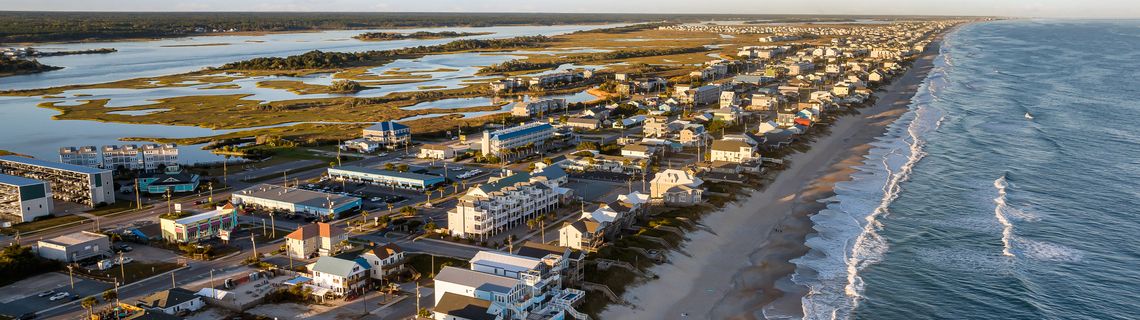
The coastal geography along the southern end of the county has fueled growth in tourism, recreation, and retirement-oriented development. The Intracoastal Waterway runs through Onslow County, and communities like Sneads Ferry and the mainland portions of Surf City have attracted a growing number of permanent residents who value waterfront access, mild winters, and proximity to Jacksonville's services without the density of larger coastal metros.
Jacksonville has experienced meaningful population growth over the past two decades, driven not only by military expansion but also by retirees choosing to remain in the area after their service ends. Many former Marines with families settle permanently in Onslow County, drawn by familiar surroundings, established social networks, and a cost of living that remains well below the national average. This retention effect adds stability to what might otherwise be a purely transient population base and creates a growing segment of property owners, small business operators, and long-term commercial tenants who are not subject to PCS transfer orders.
Infrastructure in Jacksonville has matured considerably over the past decade. The city's water and sewer systems have been expanded to support new development on the western and southern edges of the county. Road improvements along key corridors have reduced congestion, and the Albert J. Ellis Airport in nearby Richlands provides regional air service that connects Onslow County to major hubs. These infrastructure investments have made Jacksonville more attractive to businesses and developers who might have previously viewed the market as too isolated or too dependent on a single economic driver.
The retail and service economy in Onslow County punches well above its weight relative to the city's official population. The effective consumer base is far larger than the census figure suggests, because the military population includes not only service members and their families but also the civilian contractors, government employees, and support staff who work on or near the base. Daytime population in commercial corridors reflects this broader base, and sales-per-square-foot figures at well-located retail properties often rival those in significantly larger metros.
Jacksonville also functions as the commercial hub for neighboring counties with limited retail and service infrastructure of their own. Residents of Jones, Carteret, and rural Duplin counties regularly travel to Jacksonville for shopping, healthcare appointments, and professional services, extending the effective trade area well beyond the county line. This regional draw increases the addressable customer base for retail and service tenants and helps explain why Jacksonville supports a commercial density that its own population statistics would not predict.
Property Types in Onslow County
Retail is the dominant commercial property type in Jacksonville, and the volume is driven almost entirely by the spending patterns of military families. National restaurant chains, auto service centers, entertainment venues, and everyday retail line the primary corridors in unusually high density for a city of this size. The military population skews young, with disposable income supplemented by allowances, and spends aggressively on dining, fitness, personal services, and family entertainment. For retail landlords, this translates to consistent foot traffic and strong tenant interest from franchise operators who understand the military market. Jacksonville supports a concentration of quick-service and casual-dining restaurants that rivals cities two or three times its size, and franchise groups with experience in military markets actively seek locations here.
Multi-family properties benefit from one of the most reliable demand drivers in commercial real estate: Basic Allowance for Housing. BAH is a monthly stipend paid to service members who live off-base, and the rate is set by the Department of Defense based on local housing costs. This creates a predictable rent floor that landlords can underwrite with confidence. Military tenants cycle through on PCS orders every two to four years, which means turnover is constant, but so is demand. Well-located multi-family properties near base gates rarely experience extended vacancy.
The multi-family segment in Jacksonville also benefits from a structural supply constraint. New apartment construction has not kept pace with the combined demand from active-duty personnel, civilian workers, and the growing number of veterans who remain in the area after separation. This supply-demand imbalance has supported steady rent growth and kept vacancy rates below regional averages, even in older properties that might struggle to compete in markets with more abundant new construction.
Office space in Onslow County serves a concentrated set of tenants: medical and dental practices, legal services, financial advisors, and insurance agencies that cater to the military community. Medical office in particular has seen steady expansion as both military-affiliated and civilian healthcare providers add capacity to serve a growing population. Dental practices are notably prevalent in military markets, and Jacksonville supports a density of dental offices that reflects the combination of TRICARE-covered dependents seeking off-base providers and veterans accessing care through private practitioners. The demand for professional office space tends to cluster along the Western Boulevard and Marine Boulevard corridors, though newer medical and dental buildings are also appearing along the US-17 corridor as the county's population center shifts southward.
Flex and warehouse properties support the logistics, maintenance, and supply chain operations that orbit a major military installation. Contractors, equipment suppliers, and service companies that do business with the base require functional industrial space, and the inventory near the main commercial corridors sees steady absorption. Government contractors with active contracts at Camp Lejeune often need workshop, storage, and staging space within a short drive of the installation, and these tenants tend to sign longer leases tied to the duration of their federal contracts.
Hospitality benefits from a unique combination of military-related travel, visiting families, and coastal tourism. Hotels and extended-stay properties near the base gates maintain higher-than-average occupancy driven by permanent change-of-station moves, family visits during training cycles, and the seasonal beach traffic that flows through Jacksonville to reach Topsail Island and the surrounding coastal communities. Extended-stay properties in particular perform well in this market, as incoming Marines and their families often need temporary housing during the weeks between arriving on new orders and securing permanent off-base housing.
Emerging coastal commercial development along the Sneads Ferry and Surf City corridor represents a newer growth area within Onslow County. As Topsail Island continues to attract retirees, second-home buyers, and seasonal visitors, the commercial infrastructure serving those communities is expanding. Restaurants, marine services, vacation rental management offices, and neighborhood retail are filling in along the US-17 corridor south of Jacksonville proper.
Understanding BAH and Military Tenancy
Basic Allowance for Housing is the single most important concept for any investor evaluating residential or multi-family commercial real estate in a military market. BAH rates are published annually by the Department of Defense and are calibrated to local housing costs by zip code, rank, and dependency status. In the Jacksonville area, BAH rates for enlisted personnel with dependents typically support monthly rents that align closely with the prevailing rates at well-maintained apartment communities near the base gates.
For landlords, BAH functions as a quasi-guaranteed rent payment. Service members receive the stipend regardless of what they actually spend on housing, which means they have both the financial means and the incentive to secure off-base housing promptly upon arrival. Properties that are priced at or just below the BAH rate for the most common ranks tend to lease fastest and maintain the highest occupancy levels.
The PCS cycle, which moves most Marines to a new duty station every two to four years, creates a pattern of tenant turnover that is unique to military markets. While this turnover increases make-ready and leasing costs compared to markets with longer average tenancies, it also means that the incoming pipeline of new tenants never stops. A property that loses a tenant in May to a PCS transfer will typically have a replacement tenant arriving on new orders within weeks, particularly if the unit is well-located and competitively priced.
Deployment cycles add a secondary dynamic. When large units deploy overseas, some single Marines give up their off-base housing, which can create a temporary dip in occupancy at properties heavily concentrated in junior enlisted tenants. Experienced military-market landlords maintain tenant mixes across multiple ranks and family statuses to buffer against this effect, and deployment-related vacancies are typically short-lived as the housing is re-absorbed when units return or new personnel arrive to fill rear-detachment roles.
Why Invest in Jacksonville Commercial Real Estate
The fundamental investment thesis for Onslow County is federal funding. Camp Lejeune is not going anywhere. The base has been a cornerstone of Marine Corps force structure for more than eight decades, and ongoing modernization investments, including significant construction projects funded in recent defense authorization bills, reinforce its long-term strategic importance. For commercial real estate investors, this means the primary demand driver is backed by the full faith and credit of the United States government, a level of tenant security that few markets can match.
Property values in Jacksonville remain accessible relative to the income levels the market supports. Cap rates on stabilized commercial properties are generally more favorable than comparable assets in Raleigh, Wilmington, or Charlotte, offering investors stronger cash-on-cash returns at lower acquisition costs. This spread is particularly notable in multi-family and retail, where the combination of military-supported rents and below-metro pricing creates attractive yield profiles that are increasingly difficult to find in more competitive North Carolina markets.
BAH-driven rent floors provide a degree of underwriting certainty that is unusual in commercial real estate. Because the Department of Defense publishes BAH rates annually, landlords can model rental income with a level of precision that is difficult to achieve in markets driven by private-sector employment. When BAH rates increase, as they have consistently in recent years, rental rates can follow without resistance because tenants are spending a federal stipend rather than discretionary income.
The population profile in Jacksonville skews young and spending-oriented. Active-duty Marines are typically between 18 and 30 years old, often with young families, and their spending patterns favor exactly the types of businesses that occupy commercial retail space: restaurants, fitness centers, barber shops, phone stores, auto dealers, and family entertainment. This creates a reliable revenue base for retail tenants, which in turn supports landlord occupancy and rental rate stability.
Recession resistance is another compelling characteristic of this market. While private-sector employment can contract during economic downturns, military installations continue operating at full capacity. Base personnel still receive their pay, BAH checks still arrive, and the local economy continues to function at a level that insulates commercial property owners from the worst effects of broader recessions. During the 2008 financial crisis and the 2020 pandemic, Jacksonville's commercial real estate market experienced far less disruption than markets dependent on private-sector employment.
The defense spending environment also favors Jacksonville for the foreseeable future. Camp Lejeune has received substantial funding through recent National Defense Authorization Acts for facility modernization, environmental remediation, and infrastructure upgrades. These investments signal a long-term federal commitment to the installation and create secondary economic activity through construction contracts, engineering services, and the businesses that support workers involved in those projects. For investors with a multi-year hold horizon, this ongoing capital investment reinforces the stability of the local commercial property market.
High tenant velocity is a feature of military markets that can be either a risk or an advantage depending on how a property is managed. In Jacksonville, the constant flow of Marines and families arriving on new orders means that a well-located, well-maintained rental property rarely sits vacant for long. The key is understanding the timing: PCS season runs heaviest from late spring through early fall, and landlords who price correctly and market to the incoming cohort during that window can maintain occupancy rates that rival or exceed civilian markets with far less tenant turnover.
For retail investors, Jacksonville offers the unusual combination of a dense consumer base with limited e-commerce substitution for many spending categories. Military families spend heavily on services that cannot be delivered online: dining, haircuts, auto maintenance, fitness, childcare, and entertainment. This service-oriented spending pattern insulates physical retail tenants in Jacksonville from the competitive pressure that has eroded brick-and-mortar performance in many other markets. Well-located service retail in military corridors continues to lease at healthy rates and maintain strong tenant retention.
Onslow County has also been one of North Carolina's faster-growing counties over the past decade, and that growth extends beyond the military population. The US-17 corridor connecting Jacksonville to the beach communities of Sneads Ferry, Surf City, and Holly Ridge has seen accelerating residential and commercial development. Retirees, remote workers, and small-business owners are choosing coastal Onslow County for its relatively affordable real estate, mild climate, and improving infrastructure. This civilian growth layer adds upside to an already stable investment environment and diversifies the tenant base beyond pure military dependence.
Development Trends and Outlook
Jacksonville has been undergoing a gradual but meaningful transition from a military-dependent town into a more diversified small city. Downtown Jacksonville has seen renewed investment in recent years, with older commercial buildings being renovated for mixed-use purposes and new construction filling in previously underutilized parcels. The city's efforts to create a more walkable and attractive downtown core are beginning to bear fruit, with restaurants, small retailers, and professional offices choosing downtown locations over strip-center space along the highway corridors.
The healthcare sector represents the most significant growth category outside of the military economy. As Camp Lejeune's on-base medical facilities focus increasingly on active-duty care, the civilian medical infrastructure has expanded to absorb demand from military families, retirees, and the growing civilian population. New medical office construction along Western Boulevard and in emerging areas south of the city reflects this trend, and healthcare-related tenancy has become one of the most stable segments of the commercial leasing market.
Coastal development pressure from the Wilmington metro area is beginning to influence the southern edges of Onslow County. As Topsail Island and the surrounding mainland communities attract more permanent residents and higher property values, the commercial development that follows is bringing new investment into parts of the county that were previously rural or seasonal in character. This coastal growth dynamic is creating a secondary demand engine for commercial real estate that operates independently of the military economy and offers investors exposure to both market drivers within a single county.
Transportation access continues to improve. Albert J. Ellis Airport provides daily commercial service connecting Onslow County to Charlotte and other hubs, reducing the isolation that once characterized this coastal market. US-17 improvements have shortened travel times to Wilmington, and the NC-24 corridor provides a direct route west toward Interstate 40 and the broader state highway network. These connections make Jacksonville increasingly viable for regional distribution, professional services, and businesses that need to serve clients across eastern North Carolina.
Education beyond Coastal Carolina Community College is also expanding its footprint in Onslow County. Several four-year universities offer satellite programs and distance-learning centers in Jacksonville, recognizing the demand from active-duty Marines pursuing degrees during their service and from military spouses seeking educational opportunities. This growing educational presence creates additional demand for small office and classroom space and contributes to the diversification of the tenant base beyond the pure retail and service economy.
Environmental remediation at Camp Lejeune, including the ongoing response to historical water contamination issues, has brought a sustained presence of federal contractors, environmental engineers, and legal professionals to the area. While the circumstances behind this work are unfortunate, the economic activity it generates is substantial and has created demand for office space, extended-stay housing, and support services that did not previously exist in the market. This contractor population adds another layer of commercial tenancy that operates on multi-year federal contract cycles rather than military PCS timelines.
Key Areas & Corridors
Jacksonville's commercial geography is shaped by the location of Camp Lejeune's gates and the traffic patterns they create. The base occupies the southern and eastern portions of the county, pushing commercial development to the north and west. Understanding which corridors capture the highest traffic volumes from the base requires familiarity with gate locations, commuting patterns, and the residential areas where military families concentrate.
Western Boulevard and NC-24 form the primary commercial corridor in Jacksonville, running east-west from the main Camp Lejeune gates through the heart of the city's retail district. This is where the highest concentration of national retailers, restaurants, and service businesses cluster, and it handles the heaviest traffic volumes in the county. Commercial properties along Western Boulevard benefit from the daily flow of Marines and military families moving between the base and the surrounding community. Vacancy along this corridor tends to be low, and well-positioned pad sites command premium pricing.
Marine Boulevard runs parallel to Western Boulevard and represents an older commercial strip with significant redevelopment potential. Many of the buildings along Marine Boulevard date from earlier decades of Jacksonville's growth and are candidates for renovation, repositioning, or teardown-and-rebuild. Investors with a value-add approach will find opportunities here that are not available along the more fully developed Western Boulevard corridor. Acquisition costs per square foot on Marine Boulevard are typically lower than comparable frontage on Western Boulevard, and the traffic counts are still strong enough to support retail and service tenants who do not require the highest-visibility locations.
US-17 serves as the primary north-south corridor through Onslow County and is the spine connecting Jacksonville to the emerging coastal communities to the south. Growth along US-17 toward Sneads Ferry, Surf City, and Holly Ridge has been accelerating, with new residential subdivisions attracting follow-on retail, restaurants, and professional services. The northern stretch of US-17 toward Richlands and the Jones County line sees lighter commercial activity but offers lower land costs for owner-occupants and developers. The intersection of US-17 and NC-210 near the Sneads Ferry turnoff has become a notable growth node, with new commercial pad sites attracting interest from both local operators and regional franchise groups.
Piney Green Road runs through one of the densest concentrations of off-base military housing in the Jacksonville area. The commercial nodes along this corridor serve a heavily military tenant base and include convenience retail, restaurants, childcare centers, and personal services. Properties here benefit from immediate proximity to base housing areas and the associated foot and vehicle traffic. Childcare in particular is a high-demand service category near military housing concentrations, as dual-military families and service members with deployed spouses require reliable childcare arrangements that the on-base facilities cannot always fully accommodate.
Bell Fork Road and the surrounding area have seen increasing commercial development driven by residential growth on the southwest side of Jacksonville. New subdivisions and apartment communities in this area have created demand for neighborhood-serving retail and medical office that is beginning to fill in along the corridor. Bell Fork represents a growth edge of the city where commercial development is following rooftops, and early entrants are securing favorable lease terms and purchase prices relative to the more established corridors closer to the base.
The NC-24 corridor west of Jacksonville connects the city to Kenansville and ultimately to Interstate 40, serving as the primary route for commercial traffic moving between the coast and the state's interior highway system. Commercial activity along this stretch is lighter than the in-town corridors but includes truck stops, building supply operations, and agricultural services that serve the rural western portion of Onslow County. For businesses that need affordable space with highway access and do not require proximity to the base gates, this corridor offers practical options.
Sneads Ferry and Surf City corridor represents the emerging commercial frontier in Onslow County. As Topsail Island's permanent and seasonal population grows, the commercial infrastructure serving the area is evolving from a handful of beach shops and restaurants into a more developed retail and services environment. This corridor offers the most greenfield commercial development opportunity within the county, with land costs that remain significantly below the established Jacksonville corridors. Marine-oriented businesses, vacation rental management companies, and neighborhood retail serving the growing permanent population are among the tenant types driving absorption along this stretch.
Richlands and the northern corridor along NC-258 see lighter commercial activity but serve a rural residential base that extends into Jones and Duplin counties. The town of Richlands itself supports a small cluster of professional offices, convenience retail, and agricultural services. Albert J. Ellis Airport is located near Richlands, and the surrounding area has seen modest commercial growth tied to airport traffic and the rural residential population. For investors seeking lower entry points and longer-term appreciation plays, this northern fringe of Onslow County offers properties at prices well below the Jacksonville core.
Downtown Jacksonville has historically played a secondary role to the highway corridors in terms of commercial activity, but renewed investment and city planning efforts are beginning to change that dynamic. Older buildings along New Bridge Street and Court Street are being repositioned for restaurant, office, and mixed-use tenancy. The city has invested in streetscape improvements and pedestrian infrastructure downtown, and a growing number of small businesses are choosing downtown locations for their character and visibility. While downtown Jacksonville is still in the early stages of its commercial revival, the trajectory mirrors patterns seen in other small North Carolina cities where targeted public investment has catalyzed private-sector development.
Working with Sebastian in Onslow County
Jacksonville's commercial real estate market operates on its own rhythms, and understanding them requires more than a passing familiarity with the area. PCS cycles create predictable waves of tenant turnover in multi-family properties. Deployment schedules can temporarily shift spending patterns at retail locations near the base. BAH rate adjustments ripple through the rental market annually. The timing and intensity of training exercises at Camp Lejeune can affect everything from restaurant sales to apartment leasing velocity in ways that are invisible to investors without military-market experience. These are dynamics that a general commercial broker from outside the region might not factor into an analysis, but they are central to how I evaluate opportunities in Onslow County.
Military-market commercial real estate also carries considerations that do not apply in civilian markets. Base Realignment and Closure risk, while minimal for an installation of Camp Lejeune's scale and strategic importance, is a question that sophisticated investors will ask about. Changes in force structure, unit relocations, and fluctuations in troop levels can shift local demand in ways that require ongoing awareness. I track these factors as part of my market monitoring so that clients receive advice that accounts for the full picture, not just the snapshot visible in a listing brochure.
When I model investment returns for clients considering Jacksonville properties, I build in military-specific assumptions: tenant turnover rates that reflect PCS timelines, rent projections benchmarked against published BAH tables, and vacancy reserves calibrated to the realities of a military-driven market rather than generic national averages. This level of specificity helps investors make decisions grounded in how this market actually performs rather than how a spreadsheet template says it should.
For business owners seeking commercial space in Jacksonville, understanding the military customer is essential to choosing the right location. A restaurant that depends on lunchtime traffic from Marines leaving the base needs to be positioned near the right gate. A medical practice targeting TRICARE-covered dependents needs visibility in the residential corridors where military families live, not in an office park oriented toward civilian employers. These location decisions are nuanced in a military market, and I help tenants navigate them with an understanding of how traffic, spending, and daily patterns actually work in this community.
Investors from outside the region often approach Jacksonville with assumptions formed in civilian markets that do not apply here. They may overestimate vacancy risk because they see high turnover without understanding the constant replacement cycle. They may undervalue properties near the base because they view military dependence as a risk rather than a feature. Or they may miss the coastal growth story entirely because their analysis focuses only on the established corridors near Camp Lejeune. Part of my role is helping clients see the full picture and develop investment strategies that account for the dynamics unique to this market.
I cover the Jacksonville market from my base in Greenville, maintaining relationships with local property managers, landlords, and service providers who understand the military tenant landscape. This network matters in a market where off-market opportunities are common and where local knowledge about base access changes, upcoming construction projects, and tenant demand patterns can significantly impact investment performance.
Whether you are evaluating a multi-family acquisition near the base gates, looking for retail space along the Western Boulevard corridor, or exploring emerging opportunities along the coast toward Surf City, I bring the analytical rigor and local knowledge to help you move forward with confidence. My brokerage at Mullarkey Real Estate Group, Inc. provides the operational support and market reach to serve clients across every property type in Onslow County, and my CCIM candidacy ensures that the financial analysis behind every recommendation meets the standard that serious commercial investors expect.