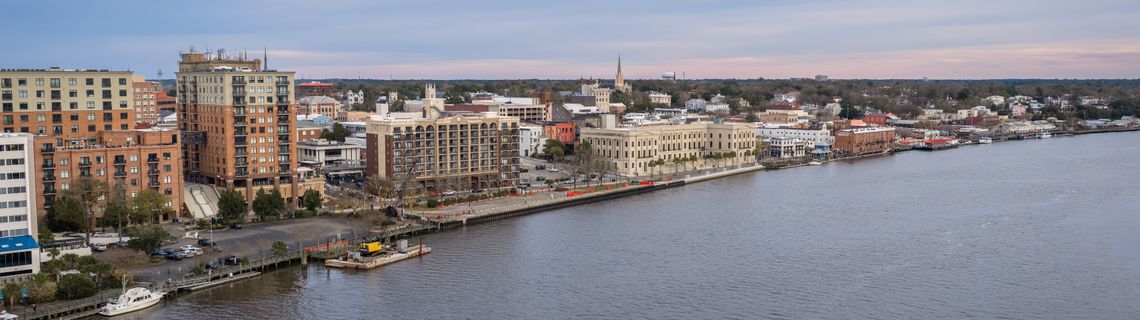
Market Overview
Wilmington sits where the Cape Fear River meets the Atlantic, and that geography has shaped the city since its founding in 1739. The Port of Wilmington is a deepwater facility operated by the North Carolina Ports Authority, handling containerized cargo, bulk materials, and cold storage shipments that move through southeastern North Carolina and into the broader Southeast logistics network. That port is not a historical artifact — it is an active economic engine that drives demand for industrial, warehouse, and logistics space across New Hanover and the surrounding counties.
The city proper has a population approaching 130,000, while the Wilmington metro area — which includes New Hanover, Brunswick, and Pender counties — exceeds 300,000 and has been one of the fastest-growing metro areas in the state for over a decade. That growth is not hypothetical. It shows up in building permits, in traffic counts on Market Street, and in the absorption rates for commercial space across every product type.
The University of North Carolina Wilmington enrolls roughly 18,000 students and employs thousands more. UNCW is not just an educational institution — it is a major employer, a talent pipeline for the regional workforce, and a generator of demand for housing, retail, and services in the corridors surrounding its campus off Randall Parkway. The university's marine science program and its partnerships with local biotech and pharmaceutical firms create a knowledge-economy layer that distinguishes Wilmington from other coastal Carolina markets.
Speaking of pharmaceutical and life sciences — this is a sector that most people outside Wilmington do not associate with the city, but it is a significant employer. PPD (now part of Thermo Fisher Scientific) built its global headquarters in Wilmington and maintains a substantial presence here. GE Hitachi Nuclear Energy operates facilities in the area. Corning has a manufacturing presence. These are high-wage employers that generate demand for Class A office space, specialized lab and R&D facilities, and the kind of housing and retail that follows well-compensated workforces.
Then there is the film and television industry. Wilmington earned the nickname "Wilmywood" for a reason. EUE/Screen Gems Studios operates one of the largest full-service film studio lots outside of California, and the state's film incentive programs have drawn productions that range from feature films to long-running television series. The production industry creates demand that is unusual for a city this size — short-term housing, specialized retail, equipment storage, and commercial space for post-production, casting, and production offices.
Tourism and the beach economy provide another demand layer. Wrightsville Beach, Carolina Beach, and Kure Beach draw visitors year-round, though the summer season is obviously the peak. The hospitality infrastructure that supports this tourism — hotels, restaurants, rental management companies, beach retail — occupies a meaningful share of the commercial real estate inventory in the county. And the trend toward permanent relocation by retirees and remote workers who initially visited as tourists has added a growth dynamic that extends well beyond the traditional summer season.
Cape Fear Community College serves the workforce training function, feeding graduates into healthcare, skilled trades, and technical roles that support the broader economy. New Hanover Regional Medical Center — now part of the Novant Health system — is a Level II trauma center and the primary acute care facility for the region. Novant Health NHRMC anchors a significant cluster of medical office, outpatient clinic, and healthcare-related commercial tenancy that extends along the 17th Street and Medical Center Drive corridors.
The combination of port logistics, university research, pharmaceutical manufacturing, film production, tourism, and healthcare creates an economic base with a level of diversification that is unusual for a city of Wilmington's size. For commercial real estate, that diversification means that no single sector's downturn can crater the market. Different demand drivers are active at different points in the economic cycle, and that resilience is reflected in Wilmington's consistently strong occupancy rates and rent growth relative to other North Carolina metro areas outside the Triangle and Charlotte.
Property Types in New Hanover County
The breadth of Wilmington's economy supports a wider range of viable commercial property types than you will find in most similarly sized markets in the Southeast. The challenge for investors and tenants is not a lack of options — it is understanding which product types align with the specific demand drivers that make this market work.
- Office. Wilmington's office market spans the full spectrum — from Class A towers and corporate campuses along Military Cutoff Road and Eastwood Road to professional office condominiums along Oleander Drive and older converted buildings in the historic downtown. Demand from pharmaceutical, financial services, and professional service tenants drives the upper end of the market, while medical office tenants, insurance agencies, and small professional firms fill the mid-market inventory. Downtown office space commands a premium tied to walkability and proximity to the courthouse, but suburban corridors along Military Cutoff and Landfall offer newer product with better parking ratios.
- Retail. New Hanover County has robust retail activity driven by a combination of resident spending, tourism, and the university population. Mayfaire Town Center represents the premier open-air retail destination in the market, anchoring the Military Cutoff corridor. Independence Mall provides enclosed mall retail, and the Oleander Drive corridor supports a wide mix of grocery-anchored, strip, and pad site retail. Downtown Wilmington offers walkable retail in a historic setting, while the beach communities support seasonal and tourism-oriented tenants with distinct lease structures.
- Industrial and port logistics. The Port of Wilmington generates demand for warehouse, distribution, and light industrial space that extends north along US-421 and into the Castle Hayne area. Cold storage facilities, container freight stations, and third-party logistics operators cluster near the port. Beyond port-related uses, Wilmington has demand for flex-industrial space from film production companies, marine services, and light manufacturing. Industrial vacancy in New Hanover County has been tight, and new speculative development has struggled to keep pace with absorption.
- Multi-family. Population growth, UNCW student demand, and the steady influx of new residents relocating from higher-cost markets have kept multi-family development active and vacancy rates low. Purpose-built student housing near UNCW operates on its own cycle, while conventional multi-family along Market Street, Kerr Avenue, and the Porters Neck corridor serves the broader workforce population. Class A garden-style and mid-rise communities along Military Cutoff and Eastwood Road target the higher-income segment, and rent growth across the market has outpaced state averages.
- Hospitality-adjacent commercial. Hotels, short-term rental management companies, beach retail, and restaurant space oriented toward the tourism economy form a distinct product type in Wilmington. Properties in Wrightsville Beach, Carolina Beach, and along the Eastwood Road restaurant row benefit from the seasonal spending surge, but the year-round population growth has extended occupancy periods and reduced the severity of off-season troughs that historically characterized this segment.
- Land. Developable land in New Hanover County is constrained — the county is one of the smallest in North Carolina by area, and water boundaries limit expansion. That scarcity puts a premium on entitled and shovel-ready sites, particularly along the Military Cutoff Road extension, in the Castle Hayne area, and along the US-421 corridor north of downtown. Land transactions in Wilmington increasingly involve assemblage, rezoning, and infrastructure negotiation rather than simple vacant-lot purchases.
The land constraint is worth emphasizing. Unlike markets where development can expand outward almost indefinitely, Wilmington is bounded by water on multiple sides and by Brunswick and Pender counties on the others. That geographic limitation creates natural supply constraints that support property values and rents over time — a structural advantage that investors in more land-rich markets do not have.
Why Invest in Wilmington Commercial Real Estate
The investment case for Wilmington rests on fundamentals that have been compounding for over two decades and show no signs of reversing. This is not a speculative market driven by a single employer or a temporary trend. The growth is structural, and the commercial real estate performance reflects it.
Population growth. The Wilmington metro has consistently ranked among the fastest-growing in North Carolina, driven by a combination of retiree relocation, remote-worker migration, and natural growth from UNCW graduates who choose to stay. This population growth creates organic demand for every commercial property type — more residents need more retail, more healthcare, more office-based services, and more housing.
Tourism overlay. Unlike purely residential markets where demand tracks population, Wilmington benefits from a tourism economy that brings spending beyond what the permanent population alone would generate. Hotel occupancy, restaurant revenue, and beach retail sales add a layer of commercial demand that operates partially independently of the local economy. In good economic times, tourism surges. In slower periods, the coastal lifestyle still draws visitors. That countercyclical quality is valuable in a commercial real estate portfolio.
Port infrastructure. The Port of Wilmington handles a growing volume of cargo, and ongoing investment in port facilities and the inland logistics network creates sustained demand for industrial and warehouse space. Port-related tenants tend to sign longer leases and require specialized facilities, which translates to lower turnover and more predictable income streams for industrial property owners. The port also attracts investment that benefits the broader economy — trucking firms, customs brokers, freight forwarders, and marine services all need commercial space to support port operations.
UNCW talent pipeline. A research university with 18,000 students generates a continuous pipeline of educated workers entering the local job market. Employers who need that talent — in healthcare, biotech, finance, and technology — have a reason to locate or expand in Wilmington, and their presence drives office and industrial absorption. The university also generates demand directly through its own research facilities, administrative offices, and campus-adjacent commercial development.
Raleigh-to-coast migration. This is a trend that has accelerated post-2020 and shows no sign of reversing. Remote and hybrid work arrangements have made it possible for professionals employed in Triangle-area companies to live on the coast. Wilmington has been the primary beneficiary of that shift within North Carolina. These migrants bring Triangle-caliber incomes to a market with lower entry costs, which supports retail spending, housing demand, and the kind of service-sector commercial activity that follows affluent households.
Supply constraints. New Hanover County's small geographic footprint and water boundaries limit the amount of developable land available. That constraint protects existing asset values, supports rent growth, and ensures that new supply enters the market at a pace that demand can absorb. Markets with unlimited land availability are vulnerable to overbuilding — Wilmington's geography provides a natural check against that risk.
Cap rates in Wilmington have compressed over the past several years as institutional investors and out-of-state capital have recognized the market's fundamentals. Entry prices are higher than in smaller Eastern NC markets, but the trade-off is better liquidity, stronger rent growth, and a deeper pool of tenants across every property type. For investors building a portfolio across Eastern North Carolina, Wilmington often serves as the anchor — the market where you place your most significant capital because the risk-adjusted returns justify it.
Key Areas & Corridors
Wilmington's commercial geography is shaped by the Cape Fear River to the west, the Intracoastal Waterway and barrier island beaches to the east, and the major arterials that connect the city's residential, employment, and retail nodes. Understanding the distinct character of each corridor is essential for making sound location and investment decisions.
Market Street (US-17 Business). This is Wilmington's oldest and longest commercial corridor, running from downtown north through Ogden and toward Porters Neck. Market Street carries the highest traffic counts in the county and supports every category of commercial tenant — from national chain restaurants and big-box retailers to independent businesses and professional offices. The southern stretch near downtown has an older, more urban character with smaller building footprints and tighter lot sizes. The northern stretch, from the I-40 interchange toward Porters Neck, is more suburban in scale with newer development and larger pad sites. Investors and tenants should understand that Market Street is not one market — it functions as three or four distinct sub-corridors with different demographics, rent levels, and competitive dynamics.
Oleander Drive. Running east-west from downtown toward Wrightsville Beach, Oleander Drive is a mature commercial corridor anchored by Independence Mall and lined with a mix of medical offices, retail centers, and professional service tenants. The corridor benefits from strong traffic counts driven by commuters moving between downtown employment centers and the beach-side residential areas. Medical office demand is particularly strong along Oleander, given its proximity to Novant Health NHRMC and the associated specialist practices. Retail along Oleander tends toward neighborhood-serving uses — grocery, pharmacy, restaurants, and personal services — rather than the destination retail found at Mayfaire.
Downtown and the riverfront. Historic downtown Wilmington is the cultural and entertainment center of the region, and it has become an increasingly active commercial real estate market over the past decade. The blocks along Front Street, Market Street, and Princess Street support a mix of restaurants, boutique retail, professional offices, and mixed-use properties. The Cotton Exchange, the Brooklyn Arts District, and the riverfront boardwalk area draw foot traffic from both residents and tourists. Class B and C office space in downtown buildings has been repositioned for creative office, coworking, and tech tenants who value the walkable environment. Development along the northern riverfront has added residential density, which in turn supports the growing base of downtown-oriented retail and restaurant tenants.
Mayfaire Town Center and Military Cutoff Road. Mayfaire is the premier retail destination in the Wilmington market — an open-air lifestyle center with national retailers, restaurants, and entertainment tenants that draws from the entire metro area. The surrounding Military Cutoff Road corridor has become the primary growth axis for Class A office, upscale retail, and mixed-use development. This corridor captures affluent spending from the Landfall, Wrightsville Sound, and Porters Neck residential communities. Office rents along Military Cutoff are among the highest in the market, and retail pad sites near the Mayfaire intersection command premium prices.
Porters Neck. Located in the northern part of New Hanover County near the Pender County line, Porters Neck has evolved from a golf-course community into a broader residential growth area with follow-on commercial development. The intersection of Market Street and Porters Neck Road has become a retail growth node, with new grocery, restaurant, and service retail following the expanding rooftop count. For investors, Porters Neck represents a growth edge where commercial development is still in relatively early stages compared to the more established corridors to the south.
Military Cutoff Road extension. The extension of Military Cutoff Road north and west has opened new development corridors and improved connectivity between the Mayfaire area and I-40. This corridor is attracting medical office, professional service, and neighborhood retail tenants who want access to the affluent east-side residential areas without paying the premium rents at the Mayfaire intersection itself. Land along the extension has been actively entitled and traded, and the corridor's buildout over the next five to ten years will meaningfully expand Wilmington's commercial inventory.
Carolina Beach Road and Monkey Junction. Carolina Beach Road (US-421) runs south from downtown toward Carolina Beach and Kure Beach, passing through the Monkey Junction area where it intersects with College Road. Monkey Junction functions as a secondary retail and services hub, with grocery-anchored retail, restaurants, and professional offices serving the growing population south of the city core. The corridor between Monkey Junction and Carolina Beach supports a mix of commercial tenants tied to beach tourism, marine services, and the permanent residential population that continues to grow in this part of the county.
Wrightsville Beach corridor. The Eastwood Road and Wrightsville Avenue corridor connecting the mainland to Wrightsville Beach is home to some of the highest-value commercial real estate in the market. Restaurant row along Eastwood Road near the Lumina Station area draws from across the metro. Wrightsville Beach itself has extremely limited commercial inventory — zoning is restrictive and land values are prohibitive for most commercial uses — but the corridor leading to the beach captures spending from the affluent permanent and seasonal population. Properties here trade infrequently and at premium valuations.
Castle Hayne and US-421 North. North of downtown along US-421 toward Castle Hayne, the commercial character shifts to industrial, logistics, and flex-industrial uses tied to the port and to the agricultural operations that remain active in the northern part of the county. This is where investors looking for industrial product will find the most available inventory and the most developable land zoned for industrial use. Proximity to the port and to I-40 via US-117 makes this corridor functional for distribution and manufacturing tenants who need highway access without paying the land costs associated with the more urban corridors closer to downtown.
Transportation & Accessibility
Wilmington's transportation infrastructure is central to its commercial real estate dynamics. The city sits at the terminus of Interstate 40, which provides a direct highway connection to Raleigh, the Research Triangle, and the broader national interstate system. That I-40 connection is a fundamental advantage — it means Wilmington is the endpoint of a major freight and passenger corridor, not a stop along the way. Commercial tenants who need to move goods or people between the coast and the interior have a direct, high-capacity route.
The Port of Wilmington is the state's primary deepwater port facility, handling containerized cargo, breakbulk shipments, and bulk materials. The port generates demand for trucking, rail, and warehouse services that extends well beyond the port boundaries themselves. Port-related commercial activity clusters along the US-421 corridor north of downtown, but its economic effects are felt across the metro area in the form of employment, spending, and infrastructure investment.
Wilmington International Airport (ILM) provides commercial air service with direct flights to major hubs including Charlotte, Atlanta, Philadelphia, Dallas-Fort Worth, and New York. For commercial real estate tenants in the pharmaceutical, finance, and professional services sectors, that air connectivity matters — it makes Wilmington viable as a location for operations that need regular face-to-face contact with clients and colleagues in larger metro areas.
US-17 runs north-south through the market, connecting Wilmington to Jacksonville and the Outer Banks to the north and to Myrtle Beach and Charleston to the south. US-421 provides the primary route to the beach communities south of the city. These highways, combined with the internal arterial network of Market Street, Oleander Drive, College Road, and Carolina Beach Road, create the traffic patterns that determine commercial property values across the county.
The transportation picture is also evolving. Ongoing improvements to I-40 interchange capacity, planned expansions along Military Cutoff Road, and long-term corridor studies for the US-17/Market Street bottleneck are all factors that will reshape commercial property values over the next decade. Investors and tenants who understand where infrastructure investment is heading can position themselves ahead of the development that follows.
Tenant Representation in Wilmington
Finding the right commercial space in Wilmington requires more than browsing listings. The market moves quickly — vacancy rates across most product types have been tight in recent years — and the best spaces often transact through relationships before they hit the open market. Tenants who wait for a perfect listing to appear are often competing with multiple offers by the time they act.
Effective tenant representation in this market starts with understanding your business model and matching it to the right corridor, the right property type, and the right lease structure. A restaurant concept that works on Eastwood Road near Wrightsville Beach may not pencil on Market Street, and vice versa. A medical practice expanding from the Oleander Drive corridor into the Military Cutoff area needs to understand how the patient demographics and competitive landscape differ between those two sub-markets. A logistics company evaluating warehouse space near the port needs to understand the infrastructure constraints and expansion options that vary from building to building.
I work with tenants to identify the right location, negotiate lease terms that protect their interests, and ensure that the financial commitment aligns with their business plan. In a market where landlords have leverage due to low vacancy, having an advisor who understands both the numbers and the local competitive dynamics is not optional — it is the difference between a lease that supports your business and one that constrains it.
Investment Sales & Dispositions
Wilmington's commercial investment market has matured significantly over the past decade. What was once considered a secondary coastal market is now attracting institutional capital, out-of-state 1031 exchange buyers, and regional investors who recognize the fundamental strength of the underlying demand drivers. That increased buyer activity has compressed cap rates and raised expectations around marketing, underwriting, and transaction execution.
For sellers, that means the disposition process needs to be handled with precision. Maximizing value in a competitive seller's market is not about listing at the highest possible price — it is about presenting the asset with clean financials, a clear tenant profile, and a market narrative that institutional buyers can underwrite. I work with sellers to prepare marketing packages that address the questions sophisticated buyers will ask before they tour the property, reducing friction in the due diligence process and accelerating time to close.
For buyers, the challenge in Wilmington is identifying opportunities where the economics actually work at current pricing. That requires understanding which sub-markets and property types still offer value relative to the broader trend, where operational improvements can create upside, and which deals are priced to perfection with no margin for error. I help buyers evaluate opportunities with the analytical rigor that prevents overpaying in a market where competitive bidding has become the norm for quality assets.
Working with Sebastian in New Hanover County
Wilmington is the largest and most complex commercial real estate market in Eastern North Carolina. The number of property types, the range of tenant demand drivers, and the level of institutional interest all create a market where the quality of your advisory relationship directly affects your outcomes. This is not a market where you can rely on intuition or a single comp to make a sound decision.
My approach is analytical first. I build financial models that reflect how Wilmington's sub-markets actually perform, not how a generic pro forma template says they should. That means accounting for the tourism seasonality that affects retail and hospitality properties, the UNCW enrollment cycle that drives student housing, the port activity levels that determine industrial absorption, and the Raleigh-to-coast migration trend that supports residential and retail demand. These are the dynamics that determine whether an investment generates the returns you underwrote or falls short.
I cover the Wilmington market as part of my broader Eastern North Carolina practice, maintaining relationships with local property managers, developers, landlords, and institutional brokers who operate in this market daily. That network provides access to off-market opportunities and market intelligence that is not available through listing platforms alone.
Whether you are evaluating a multi-family acquisition near UNCW, negotiating a retail lease at Mayfaire, looking for industrial space near the port, or considering a mixed-use development opportunity downtown, I bring the financial analysis, local knowledge, and transaction experience to help you execute with confidence.
If you are exploring commercial real estate opportunities in Wilmington or New Hanover County, I would welcome the conversation.
- Phone: (919) 797-5900
- Email: sebastian@mullarkeycre.com
- Book a meeting: syncwithsebastian.com