Market Overview
Rocky Mount occupies a unique position in eastern North Carolina. The city literally straddles two counties — Nash to the north and Edgecombe to the south — with the Tar River running through its center. This dual-county geography gives the market access to two sets of county-level incentives, two economic development organizations, and a combined labor pool that draws from both the Coastal Plain and the western edge of the I-95 corridor. The city's population of approximately 55,000 anchors a broader metro area that encompasses Nashville, Battleboro, Tarboro, and the surrounding rural communities.
The local economy has its roots in tobacco manufacturing and textile production, industries that defined Rocky Mount for much of the twentieth century. Over the past two decades, the economic base has diversified substantially. Cummins Inc. operates a major diesel engine remanufacturing facility in the city, employing over a thousand workers across its Nash County operations. Honeywell maintains aerospace manufacturing capacity in the area. QVC's East Coast fulfillment center in Rocky Mount processes millions of shipments annually and represents one of the region's largest single-site employers. These anchor employers provide the kind of stable, year-round payroll that supports demand for commercial space across property types.
Nash UNC Health Care serves as the primary hospital system for the two-county region, operating a 345-bed facility in Rocky Mount along with outpatient clinics and specialty practices throughout Nash and Edgecombe counties. The medical campus and its affiliated providers generate persistent demand for medical office space, and the hospital's role as a regional referral center brings patients, families, and visiting professionals into the city on a daily basis.
NC Wesleyan University, a private institution with its main campus on the north side of Rocky Mount, enrolls approximately 1,800 students and contributes to the local economy through both direct spending and the cultural programming that comes with a liberal arts college. While smaller than the public universities in neighboring markets, Wesleyan adds a layer of institutional stability and provides workforce development programming through its adult education division.
The most visible sign of Rocky Mount's economic evolution is Rocky Mount Mills, a 200-acre adaptive reuse development on the banks of the Tar River. The former cotton mill complex has been transformed into a mixed-use destination that includes a brewery, restaurants, event venues, residential lofts, coworking space, and a growing roster of creative and professional tenants. The project has attracted national attention and serves as a proof-of-concept for the kind of historic rehabilitation that can reposition an entire submarket. For commercial real estate investors, Rocky Mount Mills demonstrates that capital is flowing into this market and that well-conceived projects can attract tenants and visitors from well beyond the local trade area.
Federal Opportunity Zone designations cover significant portions of Rocky Mount, particularly in the Edgecombe County side of the city and parts of the downtown core. These designations create meaningful tax incentives for investors deploying capital gains into qualifying projects, and they have contributed to a noticeable uptick in development activity and investor interest over the past several years. The combination of Opportunity Zone tax benefits and Rocky Mount's fundamentally affordable price points creates an entry opportunity that is difficult to find in more competitive North Carolina markets.
Property Types in Nash & Edgecombe County
Industrial and manufacturing space remains the backbone of the Rocky Mount commercial market. The city's manufacturing heritage has left behind a substantial inventory of warehouse and production facilities, ranging from older buildings suited for value-add repositioning to modern distribution centers built to serve the I-95 logistics corridor. Cummins, Honeywell, and QVC anchor the industrial demand, but the tenant base also includes food processing operations, building materials distributors, and regional wholesalers who benefit from Rocky Mount's central position between the Triangle and the coast. Available industrial space in the market tends to price well below comparable facilities in the Raleigh metro, a spread that continues to draw users seeking lower occupancy costs without sacrificing transportation access.
Office space in Nash and Edgecombe counties serves a mix of medical practices, professional services firms, financial institutions, and government agencies. The primary office inventory concentrates along Sunset Avenue, the Benvenue Road corridor, and downtown Rocky Mount. The office market here is smaller and less institutional than in university-driven markets like Greenville, but it supports a stable base of tenants with long-term space needs. Medical office demand, driven by Nash UNC Health Care and its affiliated providers, represents a particularly resilient segment of the market.
Retail activity in Rocky Mount reflects the city's role as the primary shopping and services destination for the surrounding two-county area. Sunset Avenue and the US-301 corridor anchor the market's retail inventory, with a mix of national chains, regional operators, and locally owned businesses. Retail vacancy rates have fluctuated over the past decade as the market absorbed the loss of some legacy department store anchors, but newer concepts in fast-casual dining, discount retail, and healthcare-adjacent services have been backfilling available space. The daytime population draw from manufacturing shift workers, hospital employees, and regional shoppers creates foot traffic that supports convenience and service-oriented retail in locations with strong visibility.
Multi-family housing in Rocky Mount serves a workforce tenant base that includes manufacturing employees, hospital staff, university personnel, and service workers. Rental rates remain among the most affordable in the state, which compresses margins for investors accustomed to Triangle or Charlotte pricing but also creates opportunities for operators who can acquire at appropriate basis levels. Value-add plays in older apartment communities have attracted investor interest, particularly in properties where deferred maintenance can be addressed with moderate capital expenditure to justify rent increases. The Opportunity Zone overlay on portions of the city adds a tax efficiency layer that can improve after-tax returns on qualifying multi-family investments.
Land remains a significant property type in this market. Both Nash and Edgecombe counties offer development-ready parcels along the I-95 corridor, in established commercial zones, and on the periphery of the city's growth areas. Industrial-zoned land near the interstate interchanges attracts distribution and logistics users evaluating build-to-suit options. Commercial outparcels along Sunset Avenue and Benvenue Road draw interest from restaurant operators, convenience stores, and medical office developers. For investors with a longer time horizon, assemblages in and around Rocky Mount's Opportunity Zones present the potential for ground-up development with meaningful tax advantages.
Why Invest in Rocky Mount Commercial Real Estate
The investment case for Rocky Mount starts with the I-95 corridor. Interstate 95 is the most heavily trafficked freight route on the East Coast, and Rocky Mount sits directly on it. That positioning gives industrial and logistics tenants access to markets from Florida to the Northeast without the congestion and cost premiums associated with locations closer to major metros. For distribution operations, cold storage facilities, and regional warehousing, Rocky Mount offers a cost-to-access ratio that is difficult to beat in North Carolina.
Opportunity Zone designations provide a second layer of investment appeal. The qualified Opportunity Zone tracts in Rocky Mount cover a meaningful portion of the city's commercial footprint, including areas with established infrastructure, existing tenant bases, and proximity to the medical campus and downtown core. Investors deploying capital gains into Opportunity Zone funds can defer and potentially reduce their federal tax liability while building equity in a market with genuine upside. Unlike some Opportunity Zone designations in remote or economically stagnant areas, Rocky Mount's zones overlay neighborhoods with real commercial activity and demonstrated demand.
Affordability is a straightforward advantage. Acquisition costs per square foot for industrial, retail, and office properties in Nash and Edgecombe counties are materially lower than comparable assets in the Raleigh, Durham, or Fayetteville markets. For investors targeting cash-on-cash yield, the spread between Rocky Mount acquisition pricing and achievable rental rates supports returns that are increasingly difficult to find in more competitive markets. Cap rates for stabilized commercial properties here remain elevated relative to metro-area benchmarks, compensating investors for the additional market risk inherent in a secondary market.
Triangle spillover is an emerging dynamic worth watching. As Raleigh-Durham's growth continues to push outward, businesses and residents are looking further east for affordable space. Rocky Mount is roughly 60 miles from downtown Raleigh via US-64, a commute that has become increasingly practical as remote and hybrid work arrangements have reduced the need for daily office attendance. Early signs of this spillover are visible in residential migration patterns and in inquiries from Triangle-based businesses evaluating Rocky Mount for warehouse and back-office operations where proximity to Raleigh matters less than cost per square foot.
The manufacturing base provides employment stability that underpins commercial real estate occupancy. Cummins, Honeywell, QVC, and the constellation of smaller manufacturers and suppliers that cluster around them create thousands of jobs that support housing demand, retail spending, and the service economy. Unlike markets that depend on seasonal tourism or a single government installation, Rocky Mount's employment mix is diversified enough to provide resilience through normal economic cycles.
Downtown revitalization, anchored by Rocky Mount Mills and supported by city and county incentive programs, is creating a new demand center in an area that had been largely dormant for decades. The conversion of historic mill buildings into leasable commercial and residential space has attracted a tenant profile that includes breweries, restaurants, creative agencies, and technology companies — the kind of tenants that signal momentum to other prospective investors and occupants. For investors willing to participate in this transformation, downtown Rocky Mount offers the chance to acquire and reposition properties at a basis that reflects where the market has been, not where it is headed.
Key Areas & Corridors
Sunset Avenue is Rocky Mount's primary commercial corridor, running east-west through the heart of the city's retail and services district. National retailers, fast-food chains, grocery stores, and professional services offices line this stretch, and traffic counts are among the highest in the two-county area. Pad sites and inline retail spaces along Sunset Avenue attract the most consistent tenant demand in the market, and investor interest in well-positioned properties on this corridor has been steady. For tenant rep clients, Sunset Avenue offers the visibility and co-tenancy that drive foot traffic for consumer-facing businesses.
Benvenue Road runs north through Nash County and has emerged as a secondary commercial corridor with growing medical office, retail, and service activity. The corridor benefits from residential growth on the north side of the city and from its role as a connector between Rocky Mount's core and the Nashville area. Newer construction along Benvenue Road includes medical office buildings, quick-service restaurant pads, and neighborhood retail centers that serve the expanding residential base.
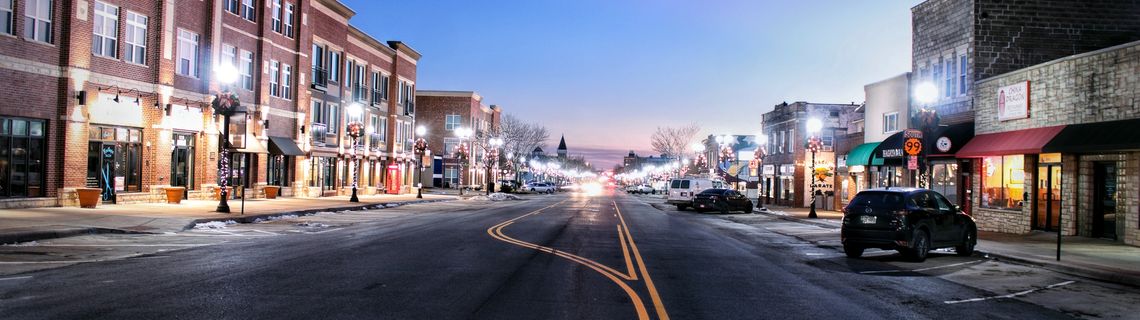
Downtown and Falls Road form the historic core of Rocky Mount, centered around the Tar River and the original commercial district. Downtown has benefited from public investment in streetscape improvements, facade grants, and infrastructure upgrades that have made the area more attractive to commercial tenants and residential developers. Falls Road connects downtown to the Rocky Mount Mills district and provides access to the parks and greenway system along the Tar River. Properties in and around downtown are priced below comparable historic-district locations in other Eastern NC markets, creating an entry point for investors and owner-occupants who recognize the trajectory of the revitalization effort.
Rocky Mount Mills deserves separate mention as both a development and a submarket. The 200-acre campus of repurposed cotton mill buildings on the Tar River has been developed into a mixed-use destination with residential, commercial, and event-oriented tenants. The project has attracted regional and even national attention, establishing a brand identity that draws visitors and prospective tenants who might not otherwise consider Rocky Mount. For commercial tenants seeking character space with exposed brick, high ceilings, and waterfront proximity, Rocky Mount Mills offers a product type that is rare in secondary markets and priced below comparable adaptive reuse space in Raleigh, Durham, or Asheville.
Nashville, the Nash County seat, sits roughly 10 miles north of Rocky Mount on US-64. The town's historic courthouse square supports a small cluster of professional offices, government services, and Main Street retail. Nashville's proximity to I-95 and its role as the county government hub provide a stable but modest commercial base. For investors, Nashville offers ultra-low entry points and the institutional demand generated by county government operations, the court system, and the attorneys and service providers that orbit the courthouse.
Battleboro and the I-95 interchange area at Exit 145 represents the market's most direct connection to the interstate highway system. This interchange supports truck stops, fuel stations, fast food, and a growing cluster of logistics-oriented users. Available land near the interchange attracts inquiries from distribution companies, travel center operators, and businesses that need tractor-trailer access and highway visibility. Battleboro's interchange positioning gives it a functional advantage that will only increase in value as e-commerce growth drives demand for regional distribution nodes along the I-95 corridor.
Transportation & Accessibility
Rocky Mount's transportation infrastructure centers on its I-95 corridor position. Interstate 95 runs through the eastern edge of Nash County, providing direct north-south connectivity to the entire Eastern Seaboard. US-64 serves as the primary east-west route, connecting Rocky Mount to Raleigh in roughly an hour to the west and to the Outer Banks to the east. US-301, the historic north-south route that preceded the interstate system, passes directly through the city and continues to function as a local commercial corridor.
The CSX rail hub in Rocky Mount is a significant logistics asset that differentiates this market from many of its peers. CSX operates a major intermodal terminal and classification yard in the city, handling freight traffic that connects the Port of Wilmington and the Port of Virginia to inland distribution points. For industrial tenants and investors, rail access adds a transportation mode that can reduce shipping costs for bulk materials, manufactured goods, and agricultural products. Properties with direct rail siding or proximity to the CSX yard command premium interest from logistics-oriented users.
Rocky Mount-Wilson Regional Airport (RWI) provides general aviation services and supports corporate and charter flights. While the airport does not offer scheduled commercial service, it gives business owners and investors direct access to the market without routing through Raleigh-Durham International, which is approximately an hour west. The airport's facilities are adequate for corporate jet traffic, and the lack of congestion makes it a practical option for executives visiting operations in the area.
Amtrak provides passenger rail service to Rocky Mount, with the station serving as a stop on the Carolinian and Piedmont routes connecting Charlotte, Raleigh, and points north through Richmond, Washington, and New York. For a secondary market, passenger rail connectivity is an unusual asset that enhances accessibility for businesses with employees or clients traveling from other East Coast cities.
Tenant Representation in Rocky Mount
For businesses searching for commercial space in Nash or Edgecombe County, working with a tenant representative ensures that you have an advisor advocating exclusively for your interests throughout the site selection and lease negotiation process. I help tenants evaluate available properties against their operational requirements, negotiate lease terms that protect their downside, and secure concessions — from tenant improvement allowances to free rent periods — that reduce occupancy costs over the life of the lease.
Industrial tenants evaluating Rocky Mount benefit particularly from local representation. The difference between a warehouse with direct I-95 access and one that requires surface-street routing can affect logistics costs for the duration of a lease. I work with manufacturing, distribution, and logistics operators to identify facilities that match their clear-height requirements, dock configurations, power capacity, and transportation needs. In a market with a diverse inventory of older and newer industrial buildings, the right facility at the right basis can save a tenant meaningful dollars per square foot over a five- or ten-year commitment.
Medical practices expanding into or within the Rocky Mount market face site selection decisions that directly affect patient access and referral patterns. Proximity to Nash UNC Health Care, visibility from Sunset Avenue or Benvenue Road, and parking adequacy all factor into location decisions that I help physicians, dentists, and allied health providers evaluate. Tenant rep in this market ensures that medical professionals are not negotiating against landlords without understanding the full range of available options and the lease structures that comparable practices have secured.
Retail operators opening locations in Rocky Mount need an understanding of traffic patterns, co-tenancy dynamics, and the trade area demographics that determine whether a site will perform. I help restaurant operators, service businesses, and specialty retailers evaluate the full cost of occupancy — base rent, CAM charges, percentage rent provisions, and build-out requirements — and negotiate terms that reflect the market's actual pricing rather than aspirational asking rates.
Investment Sales & Dispositions
Beyond tenant representation, I advise property owners and investors on acquisition and disposition strategies across Nash and Edgecombe counties. Whether you are evaluating an industrial building near the CSX yard, underwriting a value-add multi-family play in an Opportunity Zone, or considering a retail center along Sunset Avenue, I provide market-informed underwriting support, comparable sales analysis, and access to a buyer network that includes both local operators and out-of-market capital sources looking to deploy in secondary markets with yield advantages.
For sellers, I bring a marketing approach that positions Rocky Mount assets in front of investors who understand the I-95 corridor story, the Opportunity Zone overlay, and the revitalization momentum that is reshaping parts of the market. Many successful dispositions in this market depend on reaching buyers who already appreciate the thesis — manufacturing employment base, interstate logistics positioning, affordable basis, and tax-advantaged reinvestment — rather than trying to convince cold prospects that Rocky Mount deserves their attention. I leverage relationships across the eastern North Carolina brokerage community and national listing platforms including LoopNet and CREXi to ensure maximum exposure and competitive offers.
Opportunity Zone transactions require particular attention to the structuring requirements that govern qualifying investments, holding periods, and basis step-up provisions. While I am not a tax advisor and always recommend that clients engage qualified counsel and CPAs for tax-specific guidance, I understand the real estate mechanics that make a project qualify, and I help investors identify properties and development sites that fit within the Opportunity Zone framework.
Working with Sebastian in Nash & Edgecombe County
Rocky Mount is part of the broader eastern North Carolina market that I cover from my base in Greenville. My work across Nash and Edgecombe counties gives me direct knowledge of the landlords, developers, and property managers active in this market, and my involvement in transactions throughout the I-95 corridor means I understand how Rocky Mount properties compare to alternatives in Wilson, Greenville, Goldsboro, and other regional markets. When you work with me in this market, you get the benefit of a broker who understands the local dynamics and can contextualize them against the broader eastern North Carolina landscape.
As a CCIM candidate with active involvement in both tenant representation and investment sales, I bring analytical rigor to every engagement. Whether you are a manufacturer evaluating warehouse space near the interstate, an investor underwriting a multi-family acquisition in an Opportunity Zone, or a medical practice expanding into the Nash UNC Health Care orbit, I can help you identify the right opportunity, negotiate favorable terms, and close with confidence. My brokerage at Mullarkey Real Estate Group, Inc. provides the operational support and market reach to serve clients across every property type in Nash and Edgecombe counties.
If you are considering a commercial real estate transaction in Rocky Mount or anywhere in Nash or Edgecombe County, I am ready to help. Call me at (919) 797-5900, email sebastian@mullarkeycre.com, or book a call online to get the conversation started.